top of page

Each calligraphic undertaking is a journey of historical research and discovery, an insight into and an understanding of handwriting style and evolution through the centuries, a challenge to constantly exceed expectations, and a fusion of the beauty and intricacies of the past with the modernity and requirements of the present. 

Below are some examples of my calligraphic work

Calligraphy by Tracyjane

Formal English Round hand sampler by Tracyjane Rea

English Round hand / Copperplate

An elegant cursive script used in the 18th- 19th Centuries

Handwritten 1914 Letter

Character Hand writing

Creation of  different writing styles to suit the characters in a script.

15th Century style Manuscript page - Handwritten and illuminated.

Gothic writing

Gothic script also known as Blackletter, is a dense, angular, decorative calligraphic style of writing that was used in Western Europe from around 1150 to the 17th century. 

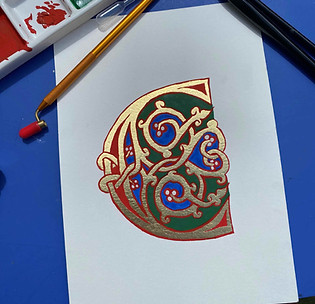
Illuminated Ottonian Manuscript style letter C.

Illumination

Illumination is the art of decorating a book or manuscript with colour, gold or silver to light up the pages for the reader.


16th Century Style manuscript page showing Chancery/ Cancellaresca writing.

Chancery/ Cancellaresca

An italic script which was adopted as the official hand of the Papal chancery in the 15th Century and then spread through Europe. It was used by England's Queen Elizabeth I.

6th Century style manuscript page - written in Merovingian script by The Flourishing Nib

Merovingian

Created after the fall of the Roman Empire, used in the Frankish Kingdoms around the 6th-8th Centuries.

Roman Cursive Script

Roman cursive

Roman cursive script, a form of handwriting used in ancient Rome, was prevalent from around the 2nd to the 7th century. It served as a quick, informal method for writing letters, business records, and other documents.


8th Century style manuscript page - written in Irish Semi-Uncial script

Uncial, Semi Uncial &

Insular scripts

Uncial scripts, widely used from the 4th to the 8th centuries, is characterized by its rounder and more open forms compared to other majuscule scripts.

19th Century Round hand handwriting, speech bubbles in the style of a  a vintage satirical cartoon for The MET.

MET Museum exhibition

In America: An Anthology of Fashion

Large speech bubbles hand written with a quill and props for an exhibition of historical fashion curated by film director.

© The Flourishing Nib
bottom of page
document.addEventListener('contextmenu', event => { event.preventDefault(); }); });